Image from the David Andrew Dunn personal collection.
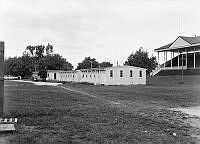
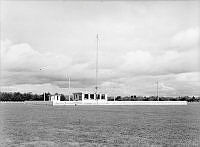
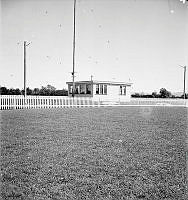
Headquarters building at RNZAF Station Gisborne.
Associated document describes: "Headquarters, RNZAF Gisborne located in front of the racecourse grandstand."
See also 1986-016.109
Image from the David Andrew Dunn personal collection.
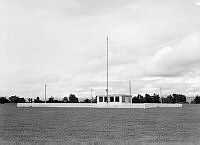
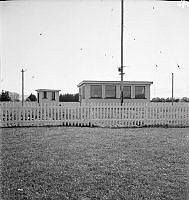
Direction finding installation at RNZAF Station Gisborne.
Associated document describes: "Medium frequency direction finding station located near [the] southern boundary of Gisborne airfield. This D/F station (and some others) used an antenna system comprising two large open single wire triangular shaped loops mounted on poles at right angles to each other. D/F stations similar to this one were constructed and operated by the NZ Post Office prior to 1939 near most of the major NZ airports primarily to provide communications and navigational facilities to civil aviation aircraft (e.g. Union Airways). The stations were also linked by a point to point radio network for the exchange of weather information, arrival and departure times of aircraft etc., and were the original "Aeradio" stations. The RNZAF took most of the stations and many of the operators over at the beginning of WWII."
See also 1986-016.111
Image from the David Andrew Dunn personal collection.
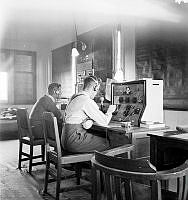
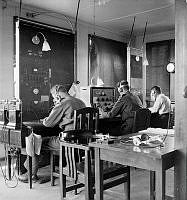
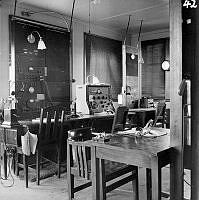
Interior view of the Direction Finding section at RNZAF Station Gisborne.
Associated document describes: "D/F set in foreground with Corporal Dunn at the controls . The operator in the background (name not remembered) is monitoring the air to ground circuit."
See also 1986-016.101, 1986-016.102, 1986-016.98, 1986-016.99
Image from the David Andrew Dunn personal collection.
Headquarters building at RNZAF Station Gisborne.
Associated document describes: "Headquarters, RNZAF Gisborne located in front of the racecourse grandstand."
See also 1986-016.110
Image from the David Andrew Dunn personal collection.
Direction finding installation at RNZAF Station Gisborne.
Associated document describes: "Medium frequency direction finding station located near [the] southern boundary of Gisborne airfield. This D/F station (and some others) used an antenna system comprising two large open single wire triangular shaped loops mounted on poles at right angles to each other. D/F stations similar to this one were constructed and operated by the NZ Post Office prior to 1939 near most of the major NZ airports primarily to provide communications and navigational facilities to civil aviation aircraft (e.g. Union Airways). The stations were also linked by a point to point radio network for the exchange of weather information, arrival and departure times of aircraft etc., and were the original "Aeradio" stations. The RNZAF took most of the stations and many of the operators over at the beginning of WWII."
See also 1986-016.112
Image from the David Andrew Dunn personal collection.
Interior view of the Direction Finding section at RNZAF Station Gisborne.
Associated document describes: "Similar to No. 42 [1986-016.98] but with operators in position. Names not remembered except that of the right hand operator - Aircraftman Hamilton."
See also 1986-016.100, 1986-016.101, 1986-016.102, 1986-016.98
Image from the David Andrew Dunn personal collection.
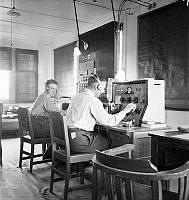
Interior view of the Direction Finding section at RNZAF Station Gisborne.
Associated document describes: "D/F set in foreground with Aircraftman Hamilton at the controls. The operator in the background (name not remembered) is monitoring the air to ground circuit."
See also 1986-016.100, 1986-016.102, 1986-016.98, 1986-016.99
Image from the David Andrew Dunn personal collection.
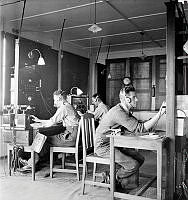
Interior view of the Direction Finding section at RNZAF Station Gisborne.
Associated document describes: "Another view of the interior of the D/F station. Aircraftman McCracken(?) in the foreground is operating the receiver used for point-to-point communications. The operator in the left foreground (name not remembered) is operating the air to ground circuit and Aircraftman Hamilton is operating the D/F receiver."
See also 1986-016.100, 1986-016.101, 1986-016.98, 1986-016.99
Image from the David Andrew Dunn personal collection.
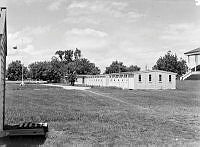
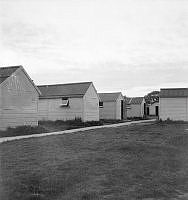
Accommodation huts at RNZAF Station Gisborne.
Associated document describes: "Airman's quarters. The RNZAF camp was located on the Gisborne racecourse."
See also 1986-016.108
Image from the David Andrew Dunn personal collection.
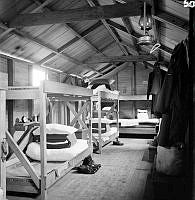
Associated document describes: "Interior view of the airman's huts shown in photos 49,52" [1986-016.107]
Image from the David Andrew Dunn personal collection.
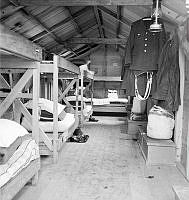
Associated document describes: "Interior view of the airman's huts shown in photos 49,52" [1986-016.107]
Image from the David Andrew Dunn personal collection.
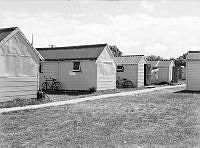
Accommodation huts at RNZAF Station Gisborne.
Associated document describes: "Airman's quarters. The RNZAF camp was located on the Gisborne racecourse."
See also 1986-016.105
Image from the David Andrew Dunn personal collection.
Interior view of the Direction Finding section at RNZAF Station Gisborne.
Associated document describes: "Interior views of the D/F (Aeradio) station showing [at] left, the rack containing on the bottom, the receiver for monitoring the band of frequencies in the region 320-350KHZ, and for ground to air communications. Each D/F station's transmitter was allocated a different spot frequency within this band. The rack panels above the receiver contained power supplies, microphone speech amplifier, telephone answering and switching panel etc.. The transmitter at a remote location was controlled by key switches on the panel below the receiver.
The central operating position is that of the D/F operator. The D/F set is an AWA C143A 8 valve superhetrodyne[?] covering the range 150-180 Meters (167-2000 KHZ) in 3 ranges. The top portion of the unit is the receiver proper with the tuning dial at the centre. The bottom sloping panel position of the unit contains the D/F controls - the large "dial" on the left being the radiogoniometer[?] for observation of D/F bearings. The NZ D/F frequency was 348 KHZ(?) being the frequency on which the D/F stations were calibrated, and for which calibration charts were constructed.
The rack near the right hand edge of the photograph probably carries an auxiliary receiver, and the box on the desk may contain a morse practice oscillator."
See also 1986-016.100, 1986-016.101, 1986-016.102, 1986-016.99
Image from the David Andrew Dunn personal collection.
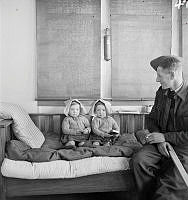
Airman with his two daughters. Gisborne.
Associated document describes: "The officer in charge of the RNZAF Gisborne M/F D/F station, Flight Sergeant Ken Tweedale with his twin daughters."
Image from the David Andrew Dunn personal collection.
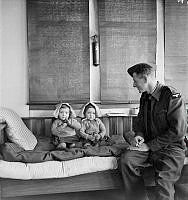
Airman with his two daughters. Gisborne.
Associated document describes: "The officer in charge of the RNZAF Gisborne M/F D/F station, Flight Sergeant Ken Tweedale with his twin daughters."
Image from the David Andrew Dunn personal collection.
Direction finding installation at RNZAF Station Gisborne.
Associated document describes: "Medium frequency direction finding station located near [the] southern boundary of Gisborne airfield. This D/F station (and some others) used an antenna system comprising two large open single wire triangular shaped loops mounted on poles at right angles to each other. D/F stations similar to this one were constructed and operated by the NZ Post Office prior to 1939 near most of the major NZ airports primarily to provide communications and navigational facilities to civil aviation aircraft (e.g. Union Airways). The stations were also linked by a point to point radio network for the exchange of weather information, arrival and departure times of aircraft etc., and were the original "Aeradio" stations. The RNZAF took most of the stations and many of the operators over at the beginning of WWII."
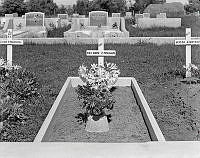
Grave of Flying Officer Clifford Morgan mid, RAF49076, Armament Officer on loan from the RAF at RNZAF Station Gisborne. Taruheru Cemetery, Gisborne.
Hit by a car in the early morning of 20 April 1943 and died the next day.
At left is the grave of Tamarangi Taihuka, 26038, and at right Private Albert Watson, 613234.
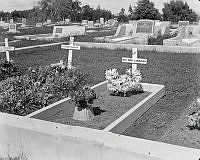
Grave of Flying Officer Clifford Morgan mid, RAF49076, Armament Officer on loan from the RAF at RNZAF Station Gisborne. Taruheru Cemetery, Gisborne.
Hit by a car in the early morning of 20 April 1943 and died the next day.
At left are the graves of Leading Aircraftman Basil Rawdon Hastings Sharp, NZ401785, and Tamarangi Taihuka, 26038.